 how-to
How to Prepare for NHIE HVAC Questions in 2026
Last Updated: October 28, 2026
Quick Summary
Start with how air and heat move through a house, then learn the components and the inspection observation each one calls for. The NHIE mechanical section rewards observing a condition and recommending professional evaluation, not diagnosing or repairing it. Build a 6 to 10 week plan, then work practice questions and close gaps. This nhie hvac prep approach keeps your effort focused on what the exam tests.
- Trace one complete air and heat path through a furnace, heat pump, boiler, and central air conditioner.
- Identify which function a question describes first: adding heat, removing heat, or moving air.
- Describe what you observe, categorize the likely causes, then recommend evaluation by a qualified professional.
- Plan for roughly 6 to 10 weeks, studying several times a week with extra review on missed topics.
- Read explanations even for correct answers, and watch keywords like most likely and first action.
Table of Contents
- HVAC Fundamentals Every Beginner Needs Before Studying
- HVAC Components and Functions for Home Inspectors
- Step 1: Build a Structured NHIE Exam Study Plan
- Step 2: Work Through NHIE HVAC Practice Questions
- Step 3: Use a Mechanical Exam Study Guide to Close Gaps
- Your Next Step: Start Your HVAC Diagnostic on Bulletproof Test Prep
- Frequently Asked Questions
The National Home Inspector Examination's mechanical content covers heating, cooling and related systems.
A common mistake is treating HVAC as a separate subject to cram at the last minute. That means you need to understand the system first and the terminology second.
Think of the mechanical section as short scenarios: a furnace that short-cycles, a heat pump running on auxiliary heat, or a condensate line draining onto a surface it should not.
- Read each question for the system type first
- Identify what the question is asking you to observe or report
- Eliminate answers that describe a repair instead of an inspection
Watch out: Many candidates confuse what an inspector reports with what a technician would fix.
HVAC Fundamentals Every Beginner Needs Before Studying
HVAC stands for heating, ventilation and air conditioning. Before you memorize terms, get a basic picture of how a house moves heat and air: most residential systems add heat to air, remove heat from air, or move air through ducts. Once that clicks, the equipment makes much more sense.
A useful beginner exercise is to trace one complete path through a house: where air enters, how it is heated or cooled, how it travels through ducts, and where it leaves.
The Three Functions Every System Performs
Every residential HVAC system performs some combination of three jobs: it adds heat, removes heat, or moves air. A furnace adds heat by burning fuel or using electric resistance; an air conditioner removes heat from indoor air and releases it outdoors; a heat pump does both depending on the mode; ducts, blowers, and registers move the air. On an exam question, first ask which function the scenario describes, that single step eliminates many wrong answers.
Heating Systems: Furnaces, Heat Pumps, and Boilers
A furnace burns fuel or uses electric resistance to heat air, then pushes it through ducts. In a gas furnace the sequence is usually: thermostat calls for heat, the inducer motor starts, the ignition system lights the burners, the blower starts after a delay, and heated air moves into the supply ducts.
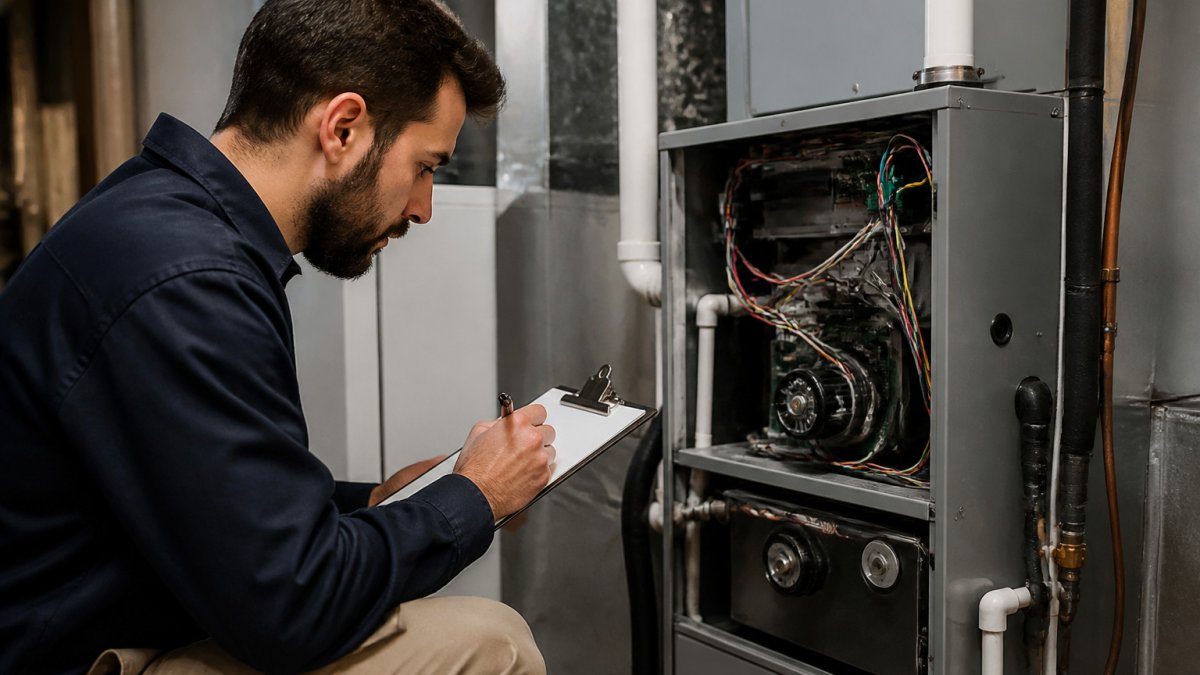
For the exam, know how each one works in plain language and what a visual inspection can and cannot confirm. You can observe whether the equipment responds to a call for heat, whether the flue is connected and intact, and whether there are signs of corrosion or improper clearances.
Cooling Systems and Refrigerant Basics
Most central air conditioners use a refrigerant cycle: the refrigerant absorbs heat indoors, releases it outdoors, and repeats. The four main components are the compressor (raises refrigerant pressure and temperature), the condenser coil (releases heat outdoors), the expansion device (drops pressure and temperature), and the evaporator coil (absorbs heat indoors).
A common beginner mistake is to treat “the AC is not cooling” as a single defect.
Ventilation and Indoor Air Quality Basics
Ventilation is the part of HVAC that beginners skip, and it shows up on the exam. Residential ventilation includes exhaust fans in kitchens and bathrooms, fresh-air intakes, and connecting ductwork. Indoor air quality questions often focus on moisture control, combustion air, and exhaust vents that terminate properly. Properly maintained systems prevent the buildup of contaminants that compromise air quality, making residential HVAC tune-ups an essential component of long-term mechanical health.
HVAC Components and Functions for Home Inspectors
Knowing the parts by name helps you answer questions quickly, but the exam rarely asks you to define a component in isolation. It asks what a component does, what a defect looks like, and what an inspector should report.
| Component | Function | What an inspector can observe |
|---|---|---|
| Air handler or furnace blower | Moves air through the ductwork | Whether the blower runs on a call for heat or cool; unusual noise or vibration |
| Heat exchanger | Transfers heat from combustion gases or refrigerant to the air | Visible cracks, rust, or scale; the exam generally expects recommendation for further evaluation, not a definitive diagnosis |
| Thermostat | Controls when the system turns on and off | Whether the system responds to a call for heat or cool; thermostat location and condition |
| Filter | Traps dust and should be checked for condition and access | Whether a filter is present, its condition, and whether it is accessible |
| Condensate drain | Removes water produced by cooling and high-efficiency furnaces | Whether the drain is connected, whether it terminates properly, and signs of overflow or leakage |
| Exhaust vent or flue | Carries combustion gases out of the home on fuel-burning equipment | Whether the flue is connected, intact, and properly sloped; signs of rust or backdrafting |
| Condenser and evaporator coils | Exchange heat in the refrigerant cycle | Whether the condenser fan runs; visible ice or debris on the coil |
| Ductwork and registers | Distribute conditioned air | Visible damage, disconnections, or obstructions; whether supply and return registers are present |
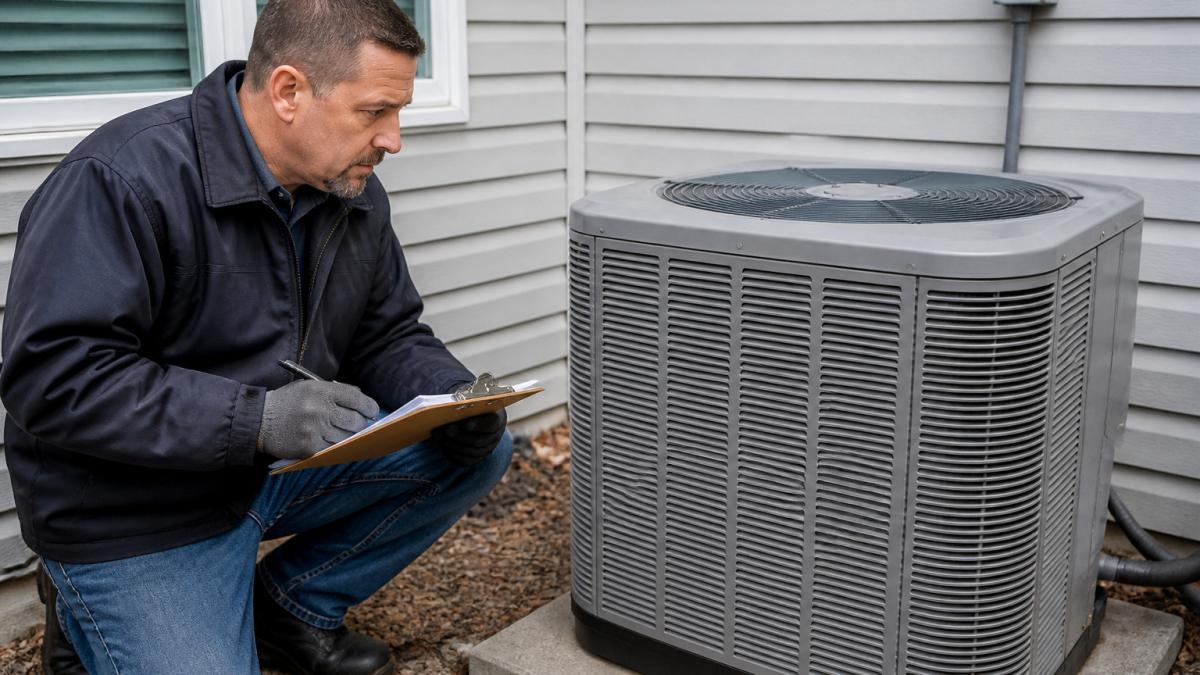
For inspection purposes, focus on what you can observe: the presence and condition of the equipment, obvious safety hazards, clearances, and whether the system appears to operate. Because a house inspection is visual and non-invasive, questions often test whether you know when something needs further evaluation by a licensed HVAC contractor.
Inspection Boundaries: What You Observe, What You Report, What You Do Not Repair
Beginners often blur the line between inspection and repair, and the exam tests that boundary directly. A home inspector observes and reports; a technician diagnoses and repairs.
A useful rule for exam questions: if an answer choice describes performing a repair, testing refrigerant charge, or diagnosing an internal component failure, it is usually wrong for an inspector. The correct answer describes the condition and recommends evaluation by a qualified professional.
Common HVAC Defects and How to Describe Them in Reports
The mechanical section rewards candidates who can translate an observation into clear report language. The examples below show the pattern: name the condition, note its implication, and recommend the next step.
- Short-cycling furnace: The furnace starts and stops more frequently than expected. Implication: possible overheating, a dirty filter, or a thermostat or pressure-switch issue. Report language: “Furnace short-cycles during operation; recommend evaluation by a qualified HVAC contractor.”
- Heat pump running on auxiliary heat: The system is using backup heat when it should be using the heat pump. Implication: possible outdoor unit or reversing valve issue, or a thermostat configuration problem. Report language: “Heat pump appears to rely on auxiliary heat; recommend evaluation by a qualified HVAC contractor.”
- Condensate line draining onto a surface it should not: Water is being discharged where it can cause damage or a slip hazard. Implication: improper termination or a clogged line. Report language: “Condensate drain terminates in an improper location; recommend correction by a qualified HVAC contractor.”
- Rust on a flue pipe: Corrosion on the exhaust vent. Implication: possible moisture or venting problem. Report language: “Rust observed on flue pipe; recommend evaluation by a qualified HVAC contractor.”
- Ice on the evaporator coil: Frost or ice buildup on the indoor coil. Implication: airflow restriction or low refrigerant charge. Report language: “Ice observed on evaporator coil; recommend evaluation by a qualified HVAC contractor.”
Example: If you see rust on a flue pipe or a cracked heat exchanger suspected by visible signs, the correct inspection response is to describe the condition and recommend evaluation by a qualified professional rather than to diagnose the internal failure yourself.
Connecting Components to Exam Questions
When a practice question describes a scenario, name the component involved before you read the answer choices. If the question describes warm air from a supply register during a cooling call, the components in play are the compressor, condenser, evaporator, and blower, and the likely categories are airflow, charge, or compressor operation. Naming the components narrows the choices and keeps you from picking an answer that sounds technical but describes a repair. Practiced on every HVAC question, that habit is the fastest way to convert component knowledge into exam points.
Step 1: Build a Structured NHIE Exam Study Plan
Start with a schedule you can actually keep. For a deeper walkthrough of building a week-by-week plan, the same-topic article covers how to pace each HVAC domain.
- Week 1-2: learn system types, components and basic airflow
- Week 3-5: study inspection observations and common defects
- Week 6 onward: take practice sets and review every missed item
Set aside time for review, not just new material. Track which HVAC topics you miss most often and give those extra sessions. The step-by-step study guides show how to create a study schedule and use practice questions effectively.
Step 2: Work Through NHIE HVAC Practice Questions
Practice questions are the fastest way to learn how the exam phrases things. Work through seven worked NHIE practice questions explained in detail to see that reasoning applied step by step.
Start with the free diagnostic to find your gaps before you commit to a full study plan. Take it under timed conditions, then use the results to choose what to study first.
Pay attention to wording. Questions with "most likely," "first action," or "should report" are testing judgment as well as knowledge. Practice spotting those keywords so you do not overthink the answer.
Step 3: Use a Mechanical Exam Study Guide to Close Gaps
After a few rounds of practice, you will have a clear list of weak spots. Close those gaps with targeted review rather than rereading everything.
Explain a system out loud as if to a client, sketch the airflow path, or write a one-sentence summary of what each component does. These proven study methods that stick when learning HVAC reinforce that kind of active recall.
Our study system is designed to help you focus effort where it matters most, with unlimited full-length practice exams to simulate test conditions.
Key Features: AI-powered study system that analyzes learning patterns, 3,500+ practice questions covering all 3 NHIE domains, unlimited full-length practice exams, money-back exam guarantee, 6-month access.
Your Next Step: Start Your HVAC Diagnostic on Bulletproof Test Prep
HVAC questions reward a clear understanding of how systems work and what an inspector should observe and report. Start with the fundamentals, study the components, then test yourself with explained practice questions until your weak areas shrink. [Start Free Diagnostic] with Bulletproof Test Prep to see where you stand and get a study plan built around what you miss.
Frequently Asked Questions
What HVAC topics should I study for the NHIE?
Focus on how heating systems such as furnaces, heat pumps, and boilers operate, how cooling systems and refrigerant circuits work, how air is moved through ductwork and filters, and how ventilation and combustion safety affect indoor air quality.
How do beginners prepare for the NHIE HVAC section?
Start with the fundamentals. Learn the function of each major component, such as the thermostat, air handler, heat exchanger, condensate drain, and exhaust vent. Track which subtopics need more attention and revisit those areas.
How many HVAC questions are on the NHIE?
The NHIE is a multiple-choice exam, and the mechanical content is one of its domains rather than a separate test. Question counts and scoring are set by the official examination provider, and they can change over time. Check the current candidate information bulletin from the official NHIE source before you schedule, so your study plan reflects the exam format you will actually face.
Are NHIE HVAC practice questions similar to the real exam?
Bulletproof Test Prep offers over 3,500 practice questions across all three NHIE domains, and its performance analytics help you track your progress.