 how-to
7 Study Methods That Actually Stick When Learning HVAC
Last Updated: October 26, 2026
Quick Summary
The best way to study HVAC is to use active recall, spaced repetition, and targeted practice on your weakest topics rather than passive reading or cramming. Understanding system architecture, electrical basics, and the refrigeration cycle forms the foundation, and hands-on experience under supervision reinforces what you learn.
- Active recall means testing yourself from memory instead of re-reading notes to strengthen retention.
- Spaced repetition reviews material at increasing intervals: after 1 day, 3 days, 1 week, and 2 weeks.
- A structured curriculum covering HVAC basics, electrical systems, refrigeration, and troubleshooting in order is more effective than jumping between topics.
- Entry-level readiness typically requires 120-200 hours of focused study plus 1,000-2,000 hours of supervised hands-on work.
- Hands-on training should start in a controlled setting like a trade school or apprenticeship with expert guidance before independent work.
Table of Contents
- Why Your Study Method Matters More Than Study Hours
- HVAC Basics for Beginners: Start With the System Architecture
- HVAC Electrical Basics: Circuits, Voltage, and Troubleshooting
- Understanding the HVAC Refrigeration Cycle and Heat Transfer
- How Long Does It Take to Learn HVAC: Realistic Timelines
- Active Study Techniques That Maximize Retention
- Building Hands-On Experience Safely and Effectively
- Starting Your Personalized HVAC Study Plan
- Frequently Asked Questions
Why Your Study Method Matters More Than Study Hours
You can spend 200 hours studying HVAC and still fail the exam. Or you can spend 80 hours with the right approach and pass comfortably. The difference isn't willpower or intelligence. It's method.
Most people study HVAC the wrong way. They read textbooks cover to cover. They watch random YouTube videos. They cram the night before. None of this builds the kind of knowledge that sticks under test pressure.
The winners use active recall, spaced repetition, and targeted practice on their weakest topics. They simulate real exam conditions. They study smarter, not longer.
This guide walks you through exactly how to study HVAC so the concepts stick. We'll cover the fundamentals you need to master, the study techniques that actually work, and how to build hands-on experience safely.
HVAC Basics for Beginners: Start With the System Architecture
HVAC systems move heated or cooled air through buildings. That's the core job. But how they do it matters for everything else you'll learn.
Every HVAC system has the same basic parts:
- Furnace or heat source, generates heat in winter
- Air conditioner or cooling unit, removes heat in summer
- Ductwork, carries air through the building
- Thermostat, tells the system when to run
- Blower, pushes air through ducts
- Filter, traps dust and debris
In winter, the furnace heats air. The blower pushes it through ducts. Warm air flows into rooms. Cold air returns to the furnace to be heated again.
In summer, the air conditioner cools the air instead. Same path, opposite direction of temperature flow.
The thermostat is the brain. When the room gets too cold, it signals the furnace to run. When the room gets too hot, it signals the air conditioner.
Understanding this loop is critical. Everything in HVAC, electrical systems, refrigeration, airflow, serves this one job: move air at the right temperature through the building.
Start by drawing this loop yourself. Label each part. Trace the airflow in winter, then in summer.
HVAC Electrical Basics: Circuits, Voltage, and Troubleshooting
HVAC systems run on electricity. You need to understand voltage, circuits, and how they fail. This is where many beginners get stuck.
Voltage is electrical pressure.
Current is the flow of electricity. It's measured in amps. A circuit breaker protects against too much current.
Resistance is what slows down electrical flow. Wires have resistance. Motors have resistance. When current flows through resistance, it creates heat.
Here's the practical part: when an HVAC system doesn't work, you check voltage first.
Common electrical failures:
- Loose connections, reduce voltage to the motor
- Blown capacitors, prevent the motor from starting
- Tripped breakers, cut power to the whole system
- Burned-out contactors, prevent the compressor from running
Study HVAC electrical by learning the circuit first. Trace power from the breaker to the thermostat to the motor.
HVAC electrical theory fundamentals from trade schools covers this in detail. You'll need to know voltage, current, and resistance cold.
[Link to internal page: NHIE Electrical Section Study Guide: Pass With Confidence]
Understanding the HVAC Refrigeration Cycle and Heat Transfer
The refrigeration cycle is how air conditioners and heat pumps move heat. This is the hardest HVAC concept for most beginners. But it's also the most important.
Heat always moves from hot to cold. This is the first law of thermodynamics. You can't reverse it.
Here's how it works:
The refrigerant starts as a liquid in the outdoor unit. The compressor squeezes it. This raises its temperature and pressure. The hot, high-pressure refrigerant flows to the indoor unit. There, it releases heat to the indoor air. The refrigerant cools down and turns into a liquid again.
The liquid flows back to the outdoor unit through an expansion valve. The valve drops the pressure. This causes the refrigerant to evaporate and cool down.
In heating mode, the cycle reverses. The indoor unit becomes the cold side. The outdoor unit becomes the hot side.
The key insight: refrigeration doesn't create cold. It moves heat. Understanding this changes how you think about HVAC systems.
Study this cycle by drawing it yourself. Label each part: compressor, condenser, expansion valve, evaporator. Draw arrows showing refrigerant flow. Understand the pressure and temperature at each point.
How Long Does It Take to Learn HVAC: Realistic Timelines
The timeline depends on your starting point and your goal.
If you're starting from zero:
- Basic understanding, 40-60 hours of study. You'll grasp how systems work and recognize common problems.
- Ready to test for entry-level work, 120-200 hours. You'll understand electrical systems, refrigeration, and troubleshooting.
- EPA Section 608 certified, 100-150 hours of focused study. This is the refrigeration certification most states require.
- NATE certified, 200-300 hours. This is the industry gold standard. It covers advanced troubleshooting and system design.
If you're in a trade school or apprenticeship:
Most programs run 12-16 weeks of classroom time, plus on-the-job training. Classroom is 30-40 hours per week. That's 400-600 hours of instruction. Add 1,000-2,000 hours of supervised hands-on work. Total time to entry-level competence: 1.5-2 years.
If you're self-studying while working:
This is common. You study 1-2 hours per week. At this pace, basic competence takes 6-12 months. Entry-level readiness takes 12-24 months.
The fastest path is structured. A trade school or online course with a clear curriculum beats random self-study. You cover material in a logical order. You get feedback. You stay accountable.
But speed isn't the goal. Retention is. A slower, more deliberate study method beats fast cramming every time.
Active Study Techniques That Maximize Retention
How you study matters more than how long you study. Here are the techniques that actually work.
Active recall is the foundation. This means testing yourself, not re-reading.
Instead, close your notes. Ask yourself a question. Try to answer from memory. This forces your brain to retrieve the information.
Spaced repetition is the second pillar. You review material at increasing intervals. First review after 1 day.
Cramming violates this. You review everything the night before the test. Your brain forgets most of it by test day.
Interleaving mixes topics instead of blocking them.
Elaboration connects new material to what you already know.
Here's a practical study session:
- First 10 minutes: review yesterday's material using flashcards (spaced repetition)
- Next 20 minutes: read new material in small chunks
- Next 20 minutes: close the book and answer practice questions on today's material (active recall)
- Last 10 minutes: mix in questions from last week's material (interleaving)
This 60-minute session is worth more than 3 hours of passive reading.
[Link to internal page: NHIE Practice Questions Online: Study Smarter]
Building Hands-On Experience Safely and Effectively
Reading about HVAC is not the same as doing HVAC. Your hands need to learn the work. But safety comes first.
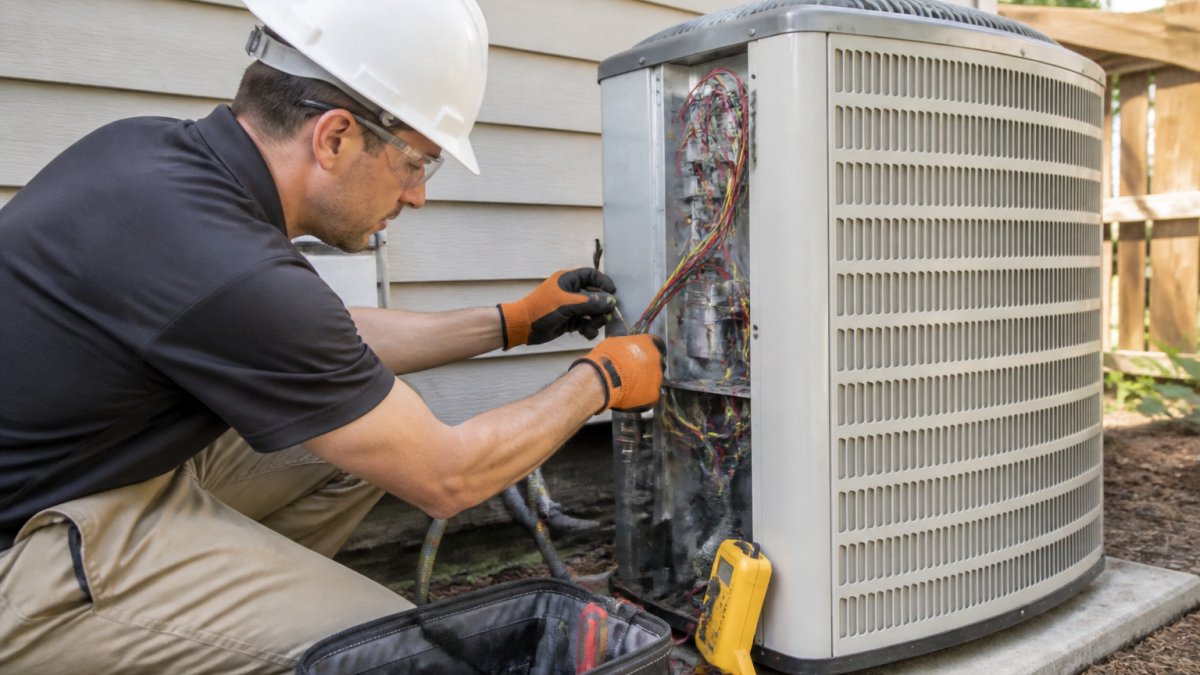
Start in a controlled setting. A trade school, apprenticeship, or supervised training program is best. You work on real equipment under expert guidance.
If you're self-studying, find a mentor. A licensed technician who will let you shadow them. You watch. You ask questions. You help with simple tasks.
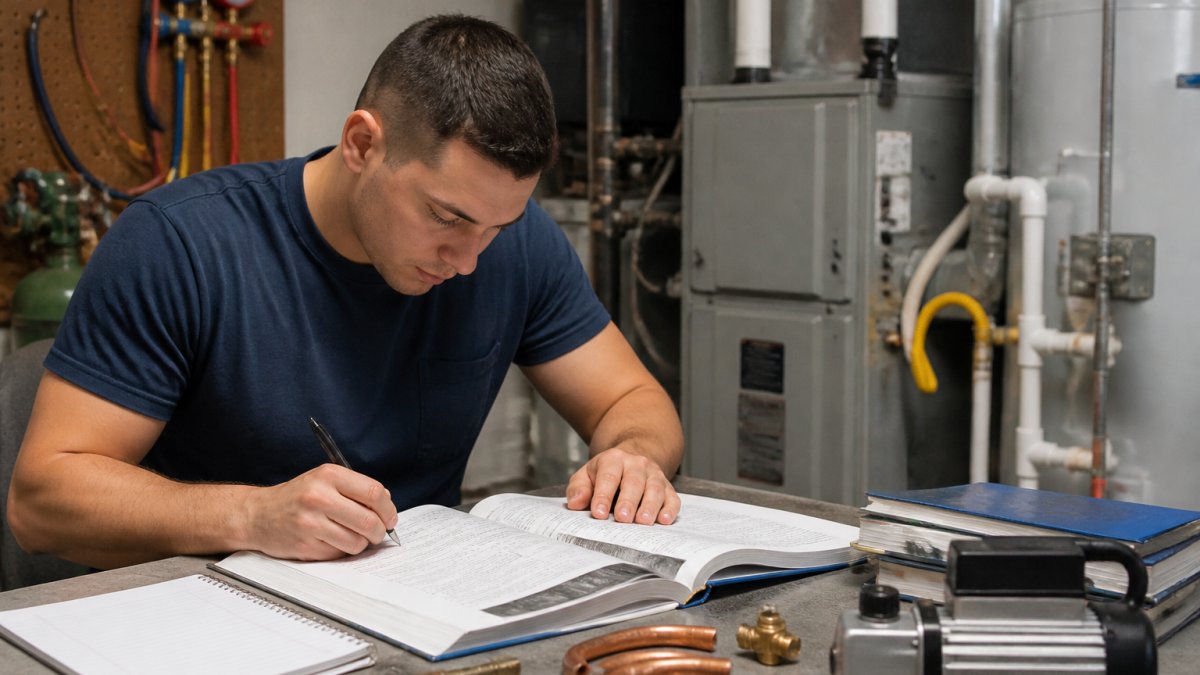
Learn the tools first. A multimeter measures voltage and resistance. A manifold gauge reads refrigerant pressure. A vacuum pump removes air from the system.
Understand the hazards.
- Refrigerant, can cause frostbite and is toxic in high concentrations
- Electrical shock, 240 volts can kill
- Hot surfaces, furnace heat exchangers reach 300+ degrees
- Confined spaces, crawlspaces and attics have limited air
Never work alone. Always follow lockout-tagout procedures. Wear safety glasses and gloves. Know where the emergency shutoff is.
Build experience in stages.
- Week 1-2: observe and ask questions
- Week 3-4: help with simple tasks under supervision
- Week 5-8: perform basic work with expert oversight
- Week 9+: work more independently, with regular check-ins
This gradual approach builds both skill and confidence. You make mistakes in a safe environment. You learn from them. You don't put customers at risk.
Starting Your Personalized HVAC Study Plan
You're ready to begin. Here's how to structure your study.
Step 1: Assess where you are. Take a diagnostic test. Bulletproof Test Prep offers a free diagnostic that covers all HVAC topics.
Step 2: Build your study schedule. How much time can you commit per week? Be honest.
Step 3: Follow a structured curriculum. Don't jump around. Study HVAC basics first. Then electrical. Then refrigeration. Then system troubleshooting.
[Link to internal page: Study Guides: Step-by-step NHIE study guides with proven strategies] break down exactly what to study each week.
Step 4: Use active study techniques. Don't just read. Use flashcards. Answer practice questions. Explain concepts out loud. Teach someone else.
Step 5: Practice with real exam questions. Bulletproof Test Prep has 3,500+ practice questions across all three NHIE domains. Use them. See which topics trip you up. Focus your study there.
Step 6: Take full-length practice exams. Simulate the real test. Same time limit. Same format. Same pressure.
Step 7: Track your progress. Bulletproof Test Prep shows detailed performance analytics.
| Study Phase | Duration | Focus | Key Activities |
|---|---|---|---|
| Foundation | Weeks 1-3 | HVAC basics, system architecture | Read guides, watch videos, take notes |
| Core Knowledge | Weeks 4-8 | Electrical, refrigeration, troubleshooting | Practice questions, flashcards, active recall |
| Depth Building | Weeks 9-12 | Weak areas identified by practice tests | Targeted study, interleaving, elaboration |
| Test Prep | Weeks 13-16 | Full exams, timed practice, review | Full-length tests weekly, review mistakes |
Your goal isn't to memorize everything. It's to understand how systems work and recognize common problems.
Start with the diagnostic. See where you stand. Then commit to the study plan. Consistency beats intensity. Show up every day.
Frequently Asked Questions
What is the best way to study HVAC if I have limited time each week?
Focus on active recall and spaced repetition rather than long study sessions. Dedicate 1-2 hours weekly to targeted practice on your weakest topics, then simulate full-length exams monthly. Prioritize HVAC basics and electrical fundamentals first, as these topics support everything else. AI-driven platforms can identify your knowledge gaps automatically, so you spend limited time where it matters most rather than re-studying material you already know.
How long does it take to learn HVAC well enough to pass certification exams?
Most people need 12-16 weeks of structured study combining online coursework, hands-on training, and focused exam prep. However, timeline varies by background: those with electrical or mechanical experience may progress faster, while beginners may need 20+ weeks. The key is consistent practice with real exam-style questions and immediate feedback. Many learners compress this by combining formal training with intensive self-study using practice exams and diagnostic assessments.
I failed the HVAC section once already. How do I avoid repeating the same mistakes?
First, identify which specific topics caused your failure, electrical circuits, refrigeration principles, or system components. Use diagnostic practice exams to pinpoint exact gaps, then study those topics in isolation before returning to full-length exams. Change your study method: if you used passive reading, switch to active problem-solving and hands-on practice. Many learners find that targeted AI-powered platforms reveal knowledge gaps their previous materials missed, allowing them to address root causes rather than surface-level confusion.
Can I learn HVAC basics and refrigeration cycles effectively through online study, or do I need in-person training?
You can master HVAC fundamentals and refrigeration theory online through quality video instruction and interactive simulations. However, hands-on practice with actual equipment, compressors, evaporators, thermostats, is essential and usually requires supervised training or apprenticeship. A hybrid approach works best: study theory online at your own pace, then gain hands-on experience through trade school, apprenticeships, or supervised field work. This combination ensures you understand both the 'why' and the 'how' needed for real-world HVAC work.
The best way to study HVAC is the way you'll actually stick with. Structure beats chaos. Active recall beats passive reading. Spaced repetition beats cramming. Find a method that fits your life, commit to it, and follow it through. Bulletproof Test Prep's AI system personalizes your study plan based on your actual performance, so you focus on what you need most. Start with the free diagnostic to see exactly where you stand, then build your study schedule from there. You've got this.