 how-to
Master NHIE HVAC Questions: A Study Plan
Table of Contents
- Why HVAC Questions Challenge Most Home Inspector Candidates
- Build Your HVAC Foundation: The Systems You'll Inspect
- Master NHIE HVAC Questions Through Structured Practice
- Use NHIE HVAC Practice Questions to Identify Your Gaps
- Study NHIE HVAC Flashcards for Quick Concept Review
- Take a Full NHIE HVAC Practice Test Under Real Conditions
- Apply Reasoning Strategies to Multiple-Choice Questions
- Common HVAC Misconceptions That Cost Test Takers Points
- Frequently Asked Questions
Last Updated: October 21, 2026
Why HVAC Questions Challenge Most Home Inspector Candidates
HVAC systems are the reason many candidates struggle with the NHIE. The material feels abstract, you're learning about heat exchangers, combustion processes, and venting standards without hands-on experience in most cases. Then the exam asks you to apply that knowledge to real-world scenarios under time pressure.
The core problem isn't the complexity. It's that HVAC questions test reasoning, not just memorization. A question might show you a furnace diagram and ask what happens if the high-limit safety control fails.
Here's what we see at Bulletproof Test Prep: candidates who master NHIE HVAC questions do one thing differently. They build a mental model of how heating systems actually function before diving into practice problems.
This guide walks you through exactly that approach. You'll build your foundation first. Then you'll practice strategically, analyze your mistakes, and identify the patterns that separate passing scores from failing ones.
Build Your HVAC Foundation: The Systems You'll Inspect
Before tackling NHIE HVAC practice questions, you need to understand what you're actually looking at. The furnace in a home isn't just a black box that produces heat. It's a system with multiple safety controls, heat transfer methods, and venting requirements. Each piece exists for a reason. Mastering these mechanical interactions provides the foundational knowledge necessary to navigate the complexities of HVAC certification requirements as you advance toward professional licensure.
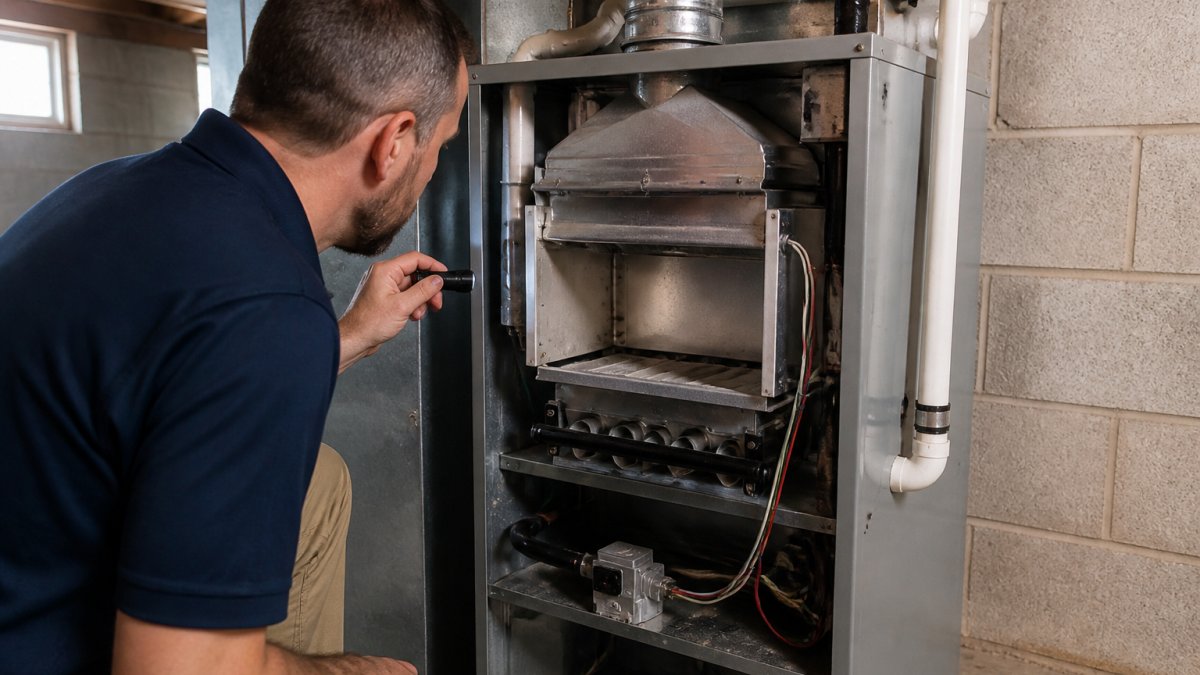
Start with the big picture: what does an HVAC system do? It heats, cools, and ventilates. For the NHIE, you'll focus heavily on heating. You need to know how a furnace generates heat, transfers it into the home, and safely vents the byproducts outside.
Furnace Operation and Heat Exchange
The furnace is where heat generation happens. Here's the sequence: fuel burns in the combustion chamber. That combustion creates heat. The heat exchanger captures that heat and transfers it to the air that flows through your home.
Heat transfer happens three ways:
- Conduction: heat moves through solid materials
- Convection: heat moves through air or liquid
- Radiation: heat travels through space
In a furnace, conduction and convection do most of the work. The hot combustion gases pass through the heat exchanger. The metal walls conduct heat outward. Air blown across those walls carries the heat into the home.
The furnace also has automatic safety controls. The high-limit setting is critical. If the furnace gets too hot, this control shuts down the burner. It prevents damage to the heat exchanger and protects the home from overheating.
Temperature control is another key concept. The thermostat signals the furnace when heat is needed. Modern systems have multiple stages of heating. A two-stage furnace can run at partial capacity for mild weather and full capacity for extreme cold.
Ventilation, Combustion, and Safety Controls
Combustion produces exhaust gases. Those gases must leave the home safely. That's where venting standards matter. The NHIE tests your knowledge of venting materials, clearances, and configurations.
Venting basics:
- Furnaces need proper draft to push exhaust out
- Venting pipes must be sized correctly for the appliance
- Clearances from combustible materials are required
- Some furnaces use PVC pipe for venting; others use metal
- Underground oil tanks require specific inspection procedures
The fireplace and other heating appliances also vent. Each has its own venting requirements. A fireplace with no chimney damper can lose heated air up the flue even when it's not in use. That's a common inspection finding.
Safety controls on furnaces include the limit switch, the flame sensor, and the draft inducer. Each serves a specific purpose. The flame sensor verifies that combustion is happening. If it doesn't detect a flame, the system shuts down to prevent gas from accumulating.
An evaporative cooler (swamp cooler) works differently than air conditioning. It uses water evaporation to cool air. These are common in dry climates. The fill pipe and air gap are specific terms you'll see on the NHIE. Understand what they do and why they matter for water safety.
Master NHIE HVAC Questions Through Structured Practice
Now that you understand the systems, practice becomes targeted. The goal isn't to memorize every question type. It's to recognize the reasoning pattern behind each question and apply it confidently.
Start with NHIE HVAC practice questions organized by topic, not randomly. Work through furnace operation questions first. Then move to ventilation and safety controls. This mirrors how your understanding actually builds.
Each practice session should have a clear purpose. Are you building speed, or building accuracy? Most candidates should prioritize accuracy first. Speed comes naturally once you know the material.
Set a target: 75% correct on your first pass through a topic. If you hit that, move forward. If not, review the foundational material again before more practice.
Track which question types trip you up. Does combustion confuse you? Do venting configurations feel unclear? That's your signal to spend extra time there. The NHIE tests the same concepts repeatedly in different scenarios.
Use NHIE HVAC Practice Questions to Identify Your Gaps
The real power of practice questions isn't getting them right. It's understanding why you got them wrong. That's where improvement happens.
When you miss a question, pause. Don't just read the explanation and move on. Ask yourself: Did I misread the question? Did I not understand the concept? Did I know the concept but made a careless mistake? These are three different problems with three different solutions.
How to Analyze Wrong Answers
Misreading happens more than you'd think. The question asks what happens if the limit switch fails. You answer based on what happens if the thermostat fails. You knew the right answer, but you answered a different question. The fix: slow down and underline the specific scenario the question describes.
Conceptual gaps are harder to spot. You might choose an answer that sounds reasonable but misses the actual principle. For example, you might think a furnace needs a bigger duct because the house is cold, when the real issue is that the duct is undersized for the volume of air the furnace produces. The fix: review the foundational concept, then come back to similar questions.
Careless mistakes happen when you rush. You know the answer but misclick or misread an option. The fix: practice under real test conditions. Time yourself. Build the habit of careful reading before you take the actual exam.
Track Patterns Across Question Types
After 20-30 NHIE HVAC practice questions, you'll start seeing patterns. Questions about heat transfer appear in multiple forms. Questions about venting standards cluster around three main scenarios. Recognizing these patterns means you're building actual understanding, not just memorizing answers.
Keep a simple log: question topic, your answer, correct answer, reason you missed it. After 50 questions, review your log. You'll see which topics need more work. You might discover that every time a question involves combustion safety, you second-guess yourself. That's a signal to build confidence in that area.
The best candidates use practice questions as a diagnostic tool. They don't just count right and wrong. They extract the lesson from each question and apply it forward.
Study NHIE HVAC Flashcards for Quick Concept Review
Flashcards work best for definitions and quick facts. What is the high-limit setting? When do you use PVC venting? What does the flame sensor do? These are perfect flashcard questions.
Build your flashcards around the core concepts, not the exam questions. The exam tests reasoning, not pure recall. But recall is the foundation. If you can't instantly define a heat exchanger, you can't reason about what happens when it fails.
Use flashcards for 10-15 minutes daily. They're meant to reinforce, not to be your primary study method. Pair them with practice questions. Do 10 flashcards, then tackle 5-10 practice questions on the same topic. That combination builds both speed and depth.
Take a Full NHIE HVAC Practice Test Under Real Conditions
At some point, you need to simulate the real exam. That means sitting down, setting a timer, and working through a full practice test without breaks or distractions.
A full NHIE practice test covers all three domains, not just HVAC. But focus on how you perform on the HVAC section.
Take your first full practice test early in your study plan. Use it as a baseline. You'll likely score lower than you expect. That's normal. The test reveals gaps that flashcards and isolated practice questions might hide.
Take a second full practice test halfway through your study plan. You should see improvement. If you're not improving, your study method isn't working. Adjust it.
Take a final full practice test one week before the real exam. This should be your strongest performance. If you're scoring 80% or higher on the HVAC section, you're ready.
Apply Reasoning Strategies to Multiple-Choice Questions
Multiple-choice questions have a structure. Understanding that structure helps you eliminate wrong answers and find the right one faster.
First, read the question before reading the answer choices. Know what you're looking for. Then read each choice carefully. Some choices are partially correct but miss the actual answer.
Common wrong-answer patterns:
- The choice is true but doesn't answer the question
- The choice is about a related concept but not the one being tested
- The choice reverses the correct principle
- The choice includes a detail that makes it incorrect
When you see a choice that's mostly right but has one detail that seems off, that's usually the trap. The NHIE tests precision. The furnace does need proper venting, but it needs venting that's sized correctly for the appliance.
Eliminate choices methodically. Cross out the obvious wrong answers first. That narrows your focus to the likely candidates. Between two choices, ask which one is more specific and precise. The NHIE rewards precision.
If you're genuinely unsure between two choices, flag the question and come back to it. Don't waste time cycling between answers. Move forward, and return when you have a fresh perspective.
Common HVAC Misconceptions That Cost Test Takers Points
Misconception one: bigger furnaces are better. Wrong. An oversized furnace cycles on and off too frequently, wastes energy, and doesn't heat evenly.
Misconception two: all venting can use PVC pipe. Wrong. Some furnaces produce exhaust hot enough that PVC would melt. Metal venting is required.
Misconception three: the thermostat controls how hot the furnace gets. Wrong. The thermostat signals when heat is needed.
Misconception four: evaporative coolers work everywhere. Wrong. They're effective only in dry climates. In humid environments, they add moisture instead of cooling.
Misconception five: venting standards are just recommendations. Wrong. Venting standards are building codes.
When you encounter a practice question that contradicts something you thought was true, treat that as a learning moment. The misconception was probably costing you points.
Mastering NHIE HVAC questions comes down to understanding the systems, practicing strategically, and analyzing your mistakes.
At Bulletproof Test Prep, we've built our platform around this exact process.
Frequently Asked Questions
What HVAC topics should I study for the NHIE?
Focus on furnace operation and components, heat transfer methods, combustion and venting standards, automatic safety controls, and system function. The NHIE tests your ability to inspect heating systems safely and identify defects. Master the difference between high-limit switches and limit controls, understand how heat exchangers work, and know venting requirements for different fuel types. These topics appear across 20-30% of the exam.
How can I use NHIE HVAC practice questions to prepare effectively?
Take NHIE HVAC practice questions in timed blocks of 15-20 questions to simulate exam conditions. After each session, review every wrong answer to identify whether you missed it due to misreading, knowledge gaps, or reasoning errors. Group your mistakes by topic (furnace, ventilation, safety controls) to see which areas need more study. Use practice questions as diagnostic tools, not just drills, they reveal exactly where your preparation is weak.
Should I use NHIE HVAC flashcards, or focus only on full practice tests?
Use both. NHIE HVAC flashcards work best for quick daily review of definitions, component names, and safety rules, spend 10-15 minutes each morning on flashcards to reinforce terminology. Then use full-length practice tests to build endurance and test reasoning under pressure. Flashcards fill gaps between study sessions; practice tests measure your overall readiness. Combine them for faster, deeper learning.
What's the most common mistake on NHIE HVAC questions?
Confusing inspection scope with repair responsibility. The NHIE tests what you must report during an inspection, not how to fix problems. Many candidates fail questions about venting, safety controls, and combustion because they don't know the difference between a defect that must be reported and a minor issue outside your scope. Study inspection reporting boundaries carefully, this distinction appears repeatedly across HVAC questions.