
I’m Matt Warner, and I help people pass their home inspection licensing exams on their first try. The question I get asked more than any other is simple: how hard is the NHIE? Here’s the reality.
The pass rate everyone whispers about
The Examination Board of Professional Home Inspectors (EBPHI), the organization that creates and administers the NHIE, does not publish an official pass rate. In fact, they never have. If you’ve Googled “NHIE pass rate,” you already know there’s no verifiable number for how many people pass or fail the exam. Things that make you go hmmm.
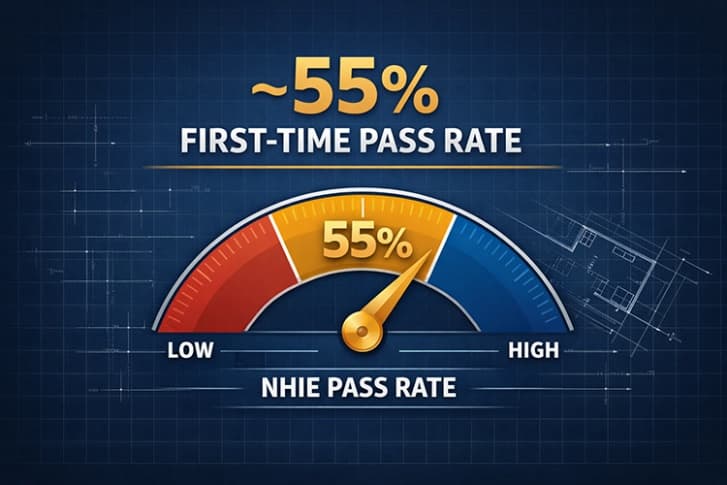
What you can find is industry consensus, repeated across major home inspection schools, training providers, and state licensing boards: roughly 55% of candidates pass the NHIE on their first attempt. That figure is most likely based on data posted by the Texas Real Estate Commission (TREC) — Texas is the only state in the country that publicly posts the results of every student’s first attempt, organized by which qualifying education provider they used. About half the people who walk into the exam end up having to pay to take it again 30 days later.
That’s the national picture. The state-level picture is where things get more interesting.
Why pass rates vary so wildly by state
Texas, where my home inspection school, The Inspection Academy, operates, has historically had one of the highest first-time pass rates in the country — around 55%. Most other NHIE states see a lower first-time pass rate. The gap isn’t because Texans are smarter. It’s because Texas requires more pre-licensing education hours than almost any other state, so candidates walk into the exam with more required preparation.
That tells you something important: the NHIE isn’t impossibly hard. It’s a test that rewards the right kind of preparation. People who study generalist material, cram facts, and never take a full-length practice exam tend to fail. People who train on the specific question style, build pacing, and use feedback loops to find their weaknesses tend to pass.
At The Inspection Academy, our first-time pass rate is 80%. The closest comparable school I know of is around 67%. That gap is not magic. It’s the difference between prep designed specifically for the NHIE and prep that treats it like any other licensing exam.
What makes the NHIE difficult
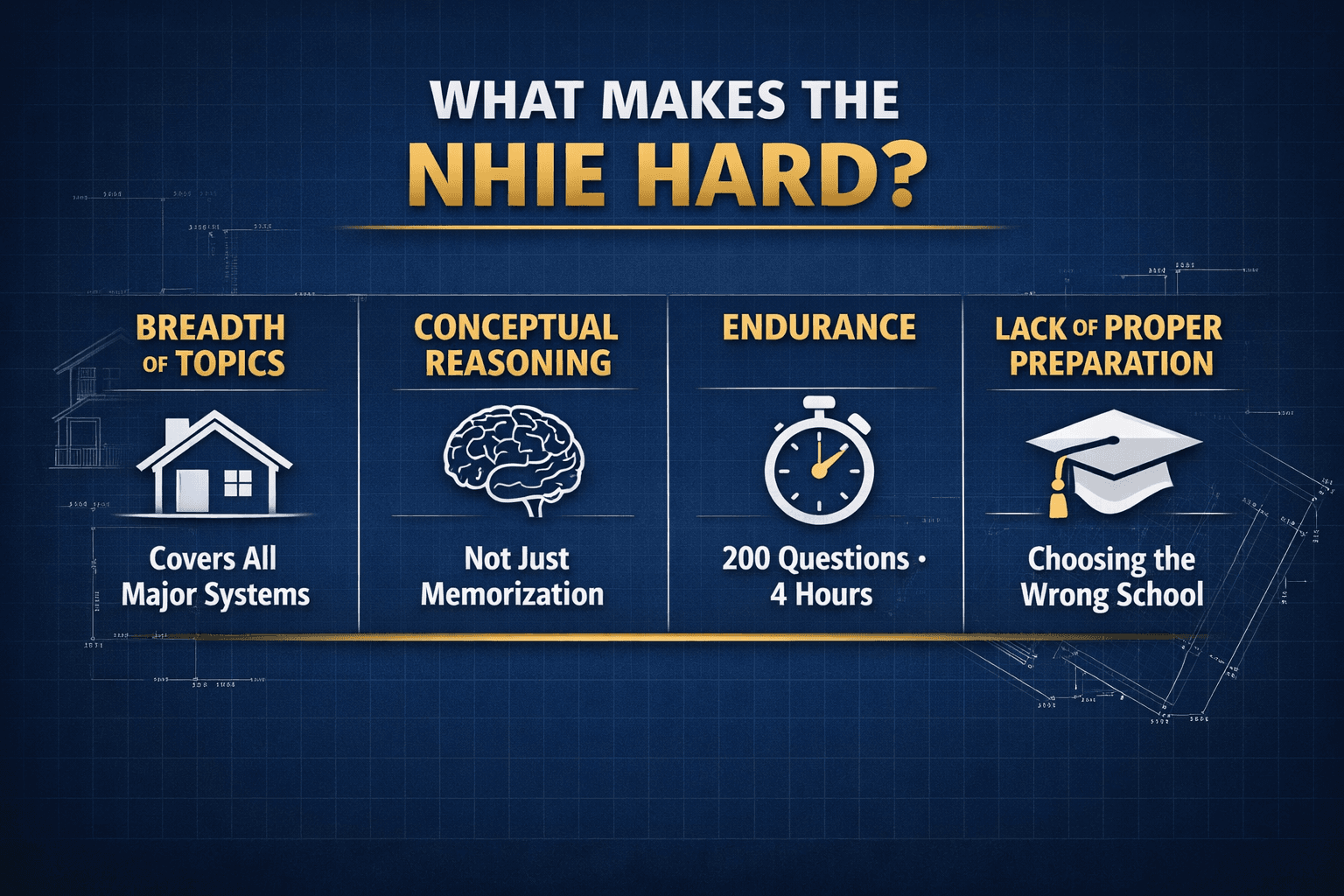
- It’s broad. The exam covers site conditions, exterior components, structural components, roofing, electrical, heating, cooling, plumbing, interiors, insulation and ventilation, and fireplace/chimney systems — every major residential building system, plus the inspection process, report writing, and business operations. Most candidates have hands-on experience with two or three of those systems and have to learn the rest.
- It’s not a memorization test. The NHIE is built around recognizing defective conditions and applying judgment. You can memorize every page of the EBPHI manuals and still fail, because the test wants to know whether you understand why something is wrong.
- It’s long. Four hours, 200 questions, closed book. If you’ve never sat for a high-stakes proctored exam — and a lot of people in this industry haven’t taken a serious test since high school — the endurance piece sneaks up on you. Pacing alone fails people who otherwise knew the material.
- The wrong school for how you learn. There are several types of qualifying education providers and several types of learners. It’s important to make sure they match — or the results aren’t likely to be successful.
The reassuring truth
Here’s what the data also shows: the NHIE is a knowable test. EBPHI publishes the content outline. The domain weighting is public. The question style follows accepted psychometric standards, which means the questions behave predictably once you’ve trained on enough of them. There’s no trick. There’s no gotcha section.
What separates first-time passers from first-time failures is almost never raw intelligence. It’s whether they trained on NHIE-specific material, took enough practice exams to build endurance, and had a feedback loop that exposed their weak spots before exam day.
What to do next
If you want to see exactly how Bulletproof Test Prep can help you prepare, take our free sample exam. Your results give you a domain-by-domain AI analysis that pinpoints the sections you’ve mastered and the sections where you’re likely to lose points on test day. It’s just a sample of what you get with the full app.
See where you stand — free
Take the free NHIE diagnostic and get a domain-by-domain AI breakdown of your readiness in minutes. No account, no credit card.
Take the free sample exam →Frequently asked questions
- What is the NHIE pass rate?
- The EBPHI has never published an official NHIE pass rate. Industry consensus — most likely based on Texas Real Estate Commission (TREC) data, the one state that publicly posts first-attempt results — puts the first-time pass rate at roughly 55%, meaning about half of candidates have to retake the exam.
- Is the NHIE hard?
- The NHIE is challenging but knowable. It is hard because it is broad (every major residential building system plus the inspection process and report writing), it rewards judgment over memorization, and it is long. It is not impossibly hard — it rewards NHIE-specific preparation rather than raw intelligence.
- How long is the NHIE and how many questions does it have?
- The NHIE is a four-hour, 200-question, closed-book exam. The length alone fails candidates who have not built test-taking endurance with full-length practice exams.
- Why do NHIE pass rates vary so much by state?
- Pass rates vary mainly because pre-licensing education requirements differ by state. Texas requires more required education hours than almost any other state, so its candidates walk in better prepared and post higher first-time pass rates (around 55%) than most other NHIE states.